Performance vs NumPy
Fair, CPU-to-CPU measurements against idiomatic single-thread NumPy — the honest baseline for the systems-performance claims that are actually stochadex’s. This is deliberately not a peak-FLOPs race against GPU frameworks (JAX, Julia SciML); those win on their own hardware and problem shapes, and when to use it says so plainly. Numbers are from an Apple M4 reference machine and are machine-specific — the full benchmark suite in the repository has every result, the methodology, and one-command reproduction.
The short version
- Single-core: at NumPy parity. On simple processes (GBM, Ornstein–Uhlenbeck) a single stochadex core now matches idiomatic NumPy’s SIMD-over-paths; on a branching process it is already ahead.
- All cores: several× faster. Independent runs as a barrier-free ensemble use every core — ~5–14× over NumPy across processes.
- Hard-to-vectorize coupling: the engine wins outright. Where the work has per-path conditionals — the case SIMD handles badly — stochadex is ~43× faster than idiomatic NumPy and beats even a hand-optimized gather/scatter.
- Warmup-free. ~1 µs from an unbuilt simulation to the first result — a statically compiled binary with no interpreter or JIT to warm up.
Whole-process simulation, across every execution model
The most representative test: simulate the same stochastic process — 10,000 paths × 2,000 steps — end to end, in NumPy (a step loop vectorized over paths, single thread) and in stochadex across each execution model it offers.
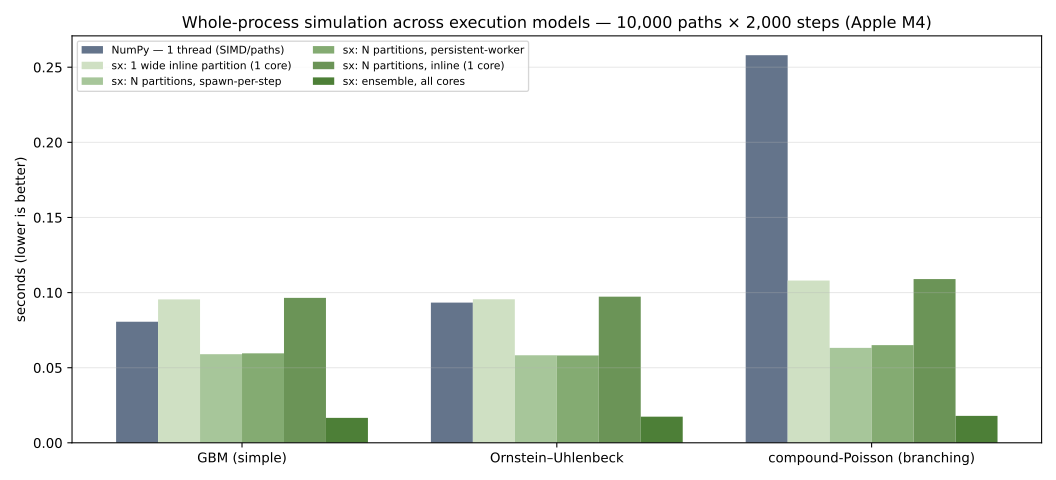
| seconds (lower is better) | GBM | Ornstein–Uhlenbeck | compound-Poisson (branching) |
|---|---|---|---|
| NumPy — 1 thread | 0.081 | 0.093 | 0.258 |
| stochadex — 1 core | 0.095 | 0.096 | 0.108 |
| stochadex — ensemble, all cores | 0.017 | 0.017 | 0.018 |
Single-core is a dead heat on GBM/OU and a ~2.4× win on the branching process; the ensemble is 4.8× / 5.5× / 14× faster than NumPy. You choose the execution model that fits the workload — NumPy gives you exactly one way to run.
Where the engine pulls ahead: hard-to-vectorize coupling
Add a per-path conditional — a responder that does expensive work only when a driver crosses a
threshold (~7% of path-steps). SIMD-over-paths cannot do this cleanly: it must either compute the
expensive branch for every path and discard ~93%, or hand-write gather/scatter index juggling.
A scalar per-path if just takes the branch.
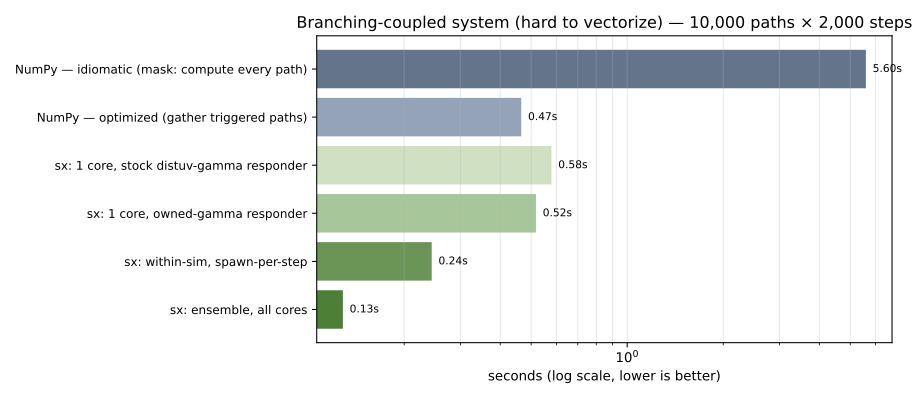
stochadex is ~43× faster than the idiomatic NumPy most people would write, and its ensemble
beats even a hand-optimized gather NumPy by 3.6× — with far simpler code (a plain if).
This is where real decision-support models live: regime switches, thresholded dispatch, event
cascades, mutually-exciting processes.
Primitive throughput isn’t sacrificed either
Per-partition vector operations (via gonum) hold their own against NumPy’s Accelerate BLAS, and the one gap — DOT — closes with a single build flag that links the same C BLAS NumPy uses.
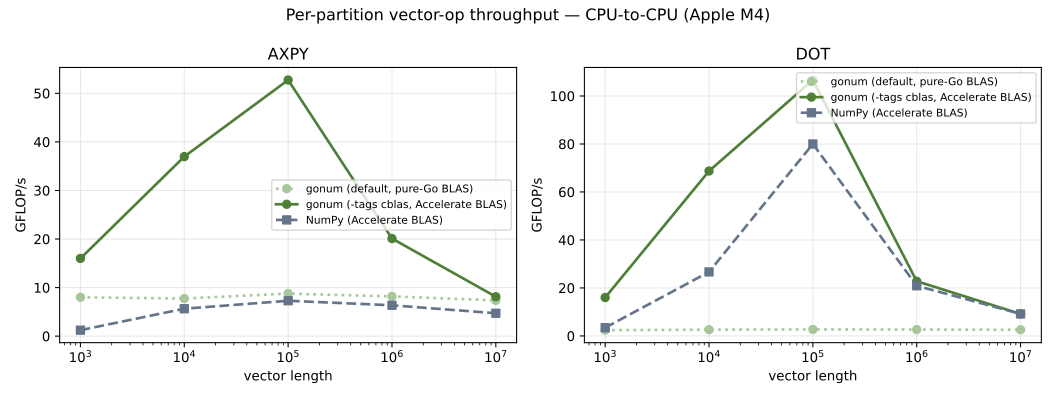
At cache-resident sizes AXPY is at parity by default; DOT jumps from ~2.7 to ~107 GFLOP/s with
-tags cblas, matching NumPy — so you keep the pure-Go / WASM-clean binary by default and get
NumPy-class BLAS when you opt in.
Reproduce it
Every number here is committed and regenerable on your own hardware. See
benchmarks/ for the full
tables (including the coupled-chain and execution-strategy benchmarks), the methodology, and the
exact commands.